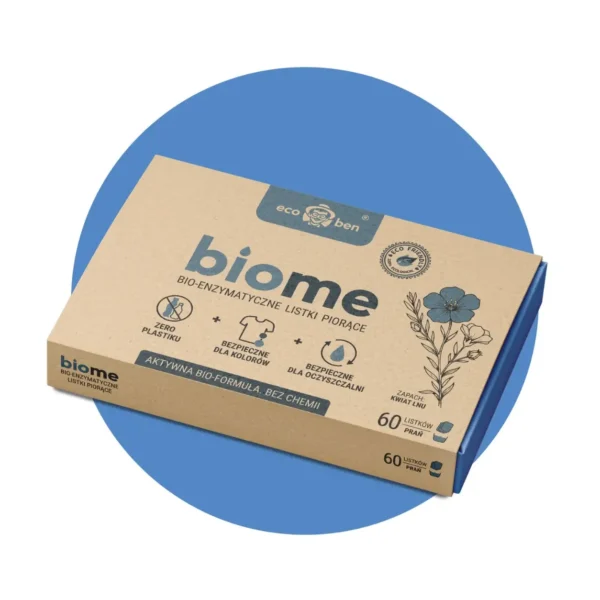

BioMe Laundry Sheets, Bio-Enzymatic Laundry Detergent
Bio-enzymatic laundry sheets, made for homes with a septic tank or treatment plant. One sheet = one wash, with no measuring and no heavy bottles.
- No phosphates, chlorine or optical brighteners: gentle on the bacteria in your system
- 4 enzymes for grease, protein, starch and bobbling
- From 30°C: 60 washes in a 120 g box
Looking for this product for your business?
We sell wholesale, to distributors and under your own brand. Tell us what you need and we will prepare an offer.
Request a wholesale offer- Manufacturer with its own laboratory
- Wholesale, private label, distribution
- Shipping from Poland across Europe
- 4 active enzymesLipase, amylase, subtilisin and cellulase for different stains
- Safe for septic tanksNo phosphates, chlorine or optical brighteners
- One sheet, one washNo measuring, no spilt detergent
- Cardboard box120 g of paper instead of heavy plastic bottles
Clean laundry. A septic tank that stays alive.
Thin sheets of detergent with four enzymes that dissolve in the washing machine. No phosphates, no chlorine, no optical brighteners. Put a sheet in the drum, load your washing and start the cycle.
- 60 washesin a 120 g box
- 4 enzymesfor grease, protein, starch and bobbling
- From 30°Cwashes well at low temperatures too
- Cardboard boxno heavy plastic bottles
Ordinary detergent ends up straight in your tank
Water from the washing machine flows into your septic tank or treatment plant, exactly where bacteria break down the wastewater. Many detergents contain phosphates, optical brighteners, chlorine or artificial dyes.
- The tank fills up faster than you’d expect
- The treatment plant cleans less well and there’s a smell outside
- You lug heavy bottles of detergent home from the shop
- Someone in the house has sensitive skin
When chemicals from the wash hold back the bacteria in your system, there are fewer of them and they work more slowly. The tank fills faster, the treatment plant cleans less well and the smell appears outside.
One sheet, one wash
Sheet in the drum
Straight onto the bottom of the drum, before the clothes. Never in the drawer.
Load the washing
As usual, no other detergent. Leave about a third of the drum free.
Start the cycle
The sheet dissolves and enzymes tackle stains: fat, protein and starch alike.
Cellulase smooths cotton fibres, so your clothes bobble less.
Dose according to how dirty the load is
Everyday wash
- Dose
- 1 sheet
- Temperature
- 30–95°C (best at 30–40°C)
- Machine
- any type, any programme
Heavily soiled
- Dose
- 2 sheets
- Temperature
- 30–95°C
- Also for
- very hard water
Hand washing: dissolve 1 sheet in a basin of lukewarm water (30–40°C), soak the clothes for 15–30 minutes, work them gently and rinse in clean water. Soak dried-in stains (blood, grease, sauce) in lukewarm water for 15–30 minutes before washing.
Don’t combine with chlorine bleach: chlorine destroys the enzymes. If you need to whiten, use an oxygen-based bleach. Handle the sheets with dry hands: moisture makes them stick together.
What this product won’t do
It isn’t a bleach
Badly yellowed whites may also need an oxygen-based bleach.
It won’t shift every stain
On extreme stains such as engine oil, tar or rust, results may be incomplete.
We don’t call it hypoallergenic
The formula has no optical brighteners or dyes, but everyone’s skin reacts differently.
What our customers ask
Where does the sheet go: in the drum or the drawer?
Always in the drum, on the bottom, before the clothes. The sheet needs direct contact with water. In the detergent drawer it might not dissolve fully.
The sheet didn’t dissolve. Why?
Most often the drum is too full or the programme is very short and cold. Leave a third of the drum free and wash at 30°C or above.
What temperature should I wash at?
Enzymes work best at 30–40°C, and the machine uses far less electricity than at 60°C. The sheets work up to 95°C, but above 60°C the enzymes lose their activity. Only wash hotter when the care label calls for it.
Are they safe for septic tanks and treatment plants?
The sheets were designed for homes with a septic tank or treatment plant. They contain no phosphates, optical brighteners or chlorine, which are exactly the ingredients that upset the bacteria in your system the most. The main washing agent is 95% broken down within 28 days (OECD 301 test).
Can I wash wool or silk?
The sheets are for cotton, linen, synthetics and blends. For wool and silk, always check the care label and choose the right programme. Very delicate fabrics are best washed by hand.
What’s the difference between the three scents?
The washing formula is the same; only the scent differs. Linen Flower is subtle and natural. Rose and Ebony is a deep floral note with dark accents of ebony. Fine Wood is a warm woody note with hints of cedar and pepper.
How many washes are in a box?
There are 60 sheets in the box, so 60 everyday washes. If you use a double dose for heavily soiled loads, it’s enough for 30 washes. Net weight: 120 g.
Everything you need to know
Ingredients
In line with the Detergents Regulation (EC 648/2004): over 30% anionic surfactants, 15–30% non-ionic surfactants, less than 5% enzymes (lipase, amylase, subtilisin, cellulase), perfume. The main washing agent is sodium lauryl sulphate (SLS), derived from vegetable fats. No phosphates, chlorine, optical brighteners or synthetic dyes.
What is the sheet made of?
PVA (polyvinyl alcohol), a synthetic polymer that dissolves in water. How quickly it breaks down depends on the type of PVA and the conditions in the treatment plant: this is still being debated in the scientific community, and we want you to know that.
Storage
- In the tightly closed box, somewhere cool and dry (up to 25°C)
- Away from sunlight and moisture: the bathroom isn’t the right place
- Out of reach of children, away from food
CLP classification and precautions
This product is not classified as hazardous under CLP (EC 1272/2008). Contains enzymes: may produce an allergic reaction in people sensitive to enzymes. Do not swallow. If sheet material gets on your skin, wash with soap and water.
First aid
- Eyes: rinse with plenty of water for several minutes, keeping the eyelids wide open. Remove contact lenses, if worn.
- Skin: wash with soap and water.
- Emergency number: 112 in the EU, or your local emergency number.